OTE - Oregon Travel Experience

Boone’s Ferry

Posted on: October 4th, 2024 in Historical Marker Audio Tours, Historical Marker Details |

During the period of Oregon’s Provisional Government (1841-1849), residents traveled by Indian trails, water courses, or on primitive rough-hewn wagon roads etched by emigrant settlers. During the days of the Territorial Government (1849-1859), and long before the State Highway Commission was established in 1914, travel and commercial transportation was often the result of ambitious, enterprising Oregonians such as the Alphonso Boone family of Clackamas County. Alphonso Boone, grandson of frontiersman …
Read More

TIC Careers and Employment

Posted on: September 18th, 2024 in News & Press |

The Travel Information Council is hiring for multiple positions, in multiple locations around the state of Oregon. Are you seeking an opportunity to shape the quality and features of Oregon’s Highway Rest Areas to tangibly improve the experience for the millions of travelers who use them each year?

Careers

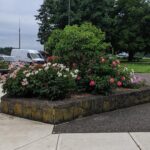
Everything is coming up roses at French Prairie Rest Area.

Beaver Hill Mine

Posted on: September 12th, 2024 in Historical Marker Details |

This is Beaver Slough- a resource gathering area and major travel corridor for the Hanis and Miluk people (Coos Bay estuary) and the Athabaskan speaking people (Coquille River). This was once Oregon’s only commercially developed coal region. Euro-Americans settled here in the 1850s. By 1893, the region’s first railroad ran alongside Beaver Slough, transporting coal to a hungry steam-power market. In 1895, 11 Black miners from West Virginia were recruited …

Read More

Beacon Rock

Posted on: September 12th, 2024 in Historical Marker Details |

Beacon Rock is a monolith, the core of a young volcano that erupted around 57,000 years ago. It is claimed to be the second largest freestanding monolith in the world. Lewis and Clark named it Beacon Rock in 1805. Native peoples and Lewis and Clark recognized that Beacon Rock marked the last of the rapids on the Columbia River and the beginning of tidal influence from the Pacific Ocean, 150 …

Read More

Balloon Bomb

Posted on: September 12th, 2024 in Historical Marker Details |

*

Very near here, on a warm spring day in 1945, six people- a woman and five children- were killed by a Japanese “balloon bomb,” or Fugo. The party had arrived for a picnic when they discovered the deflated balloon. While they gathered around the strange device, it exploded. These were the only civilian casualties of the war within the continental US. The bombs were launched 6,000 miles away in japan …

Read More

Baker

Posted on: September 12th, 2024 in Historical Marker Audio Tours, Historical Marker Details |

In October 1861, a group of prospectors in search of the mythical Blue Bucket Mine, made camp on a creek six miles southwest of here. That evening, Henry Griffin discovered gold in the gulch which bears his name. That started a stampede which continued for years. In 1862, Baker County was created and named for Colonel E.D. Baker, U.S. Senator from Oregon. The present town of Baker was an important …

Read More

Aurora

Posted on: September 12th, 2024 in Historical Marker Details |

Dr. Wilhelm Keil founded here a Christian co-operative colony patterned after his colony at Bethel, Missouri. Musicians of the settlement made it widely famous. After Dr. Keil’s death in 1877 the communal enterprise was dissolved.

Location: Corner of Liberty at 3rd Street, Aurora, OR

Learn More: Visit Oregon Encyclopedia

Applegate Trail

Posted on: September 12th, 2024 in Historical Marker Details |

The first emigrant train over the “Southern Route” including more than fifty wagons under the leadership of Captain Levi Scott and David Goff, left the Oregon Trail at Fall Creek or Raft River on the Snake River, August 10, 1846. The Klamath River was crossed eight miles upstream from this sign on October 4, 1846. This trail, roughly 680 miles, took fifty-six days of travel. Captain Scott, leading the second …

Read More

Ancient Indian Fishing Grounds

Posted on: September 12th, 2024 in Historical Marker Details |

Before a network of dams controlled the Columbia River it was often a raging torrent. Here at Wyam Falls, known today as Celilo Falls, a vertical drop of more than 20 feet and sheer basalt bluffs on either shore forced the river into seething, boiling rapids.

From time immemorial this region comprised the fishing grounds of all Indian tribes of the middle Columbia River area. Early Indians speared huge salmon while …

Read More

American Indian Seasonal Round

Posted on: September 12th, 2024 in Historical Marker Details |

American Indians have occupied portions of the northern Great Basin for 10,000 years. The region’s earliest inhabitants lived in caves and camps along the shores of glacial lakes and marshes. This area was the homeland of the “Wada-tika” (wada seed eaters), a band of the Northern Paiute Indians. They often camped near this site between Malheur and Harney lakes called “The Narrows,” and collected seeds from the seepweed (Suaeda sp.) …

Read More